
ESTD : 1918 | TYPE : Government | AFFILIATION : N.M.C | RECOGNITION : W.H.O

The People’s Commissariat of Health was established as a part of the Council of People’s Commissars on July 11, 1918.The foundation of the Medicine of Turkestan was based on during that period. The People’s Commissariat of Health made several important decisions in the field of healthcare in the first years of its activity. One of them is the approval on March 13, 1919 of the Regulations on the management of medical institutions in the Republic of Turkestan. On April 13, 1919, a decision was made to organize a medical faculty as the part of the Turkestan State University. On September 17, 1919, at the first academic council of Turkestan State University, Professor P.P. Sitkovsky was appointed as a dean of the new medical faculty and K.G. Khrushyev as a deputy. 1919-1921 was the organizational period of the faculty, when its material and technical base were being created. During that period I.V. Davidovsky, A.N. Kryukov, P.P. Sitkovsky, V.F. Voyno-Yasenetskiy, K.G. Khrushyev, G.B. Berlatskiy had worked as the heads. S.N. Naumov, M.I. Prozin, G.G. Shcheglov, A.V. Miller, V.K. Arkadyev, I.P. Rojdestvensky, S.E. Zimmerman, A.A. Yudin, E.M. Shlyahtin, O.B. Lepeshinskaya, I.A. Smorodintsev, M.A. Zaharchenko, V.V. Vasilyevsky, M.S. Astrov, M.M. Nevyadomsky, G.S. Bom, G.A. Ilyin, N.I. Ragoza, A.N. Murzin, I.S. Milman, N.I. Osinovsky, F.I. Walker, S.A. Molchanov, G.N. Terehov and others were invited as teachers. On May 5, 1920 the Faculty of Medicine was provided with a cadet corps for accommodation and a hospital with 500 beds.
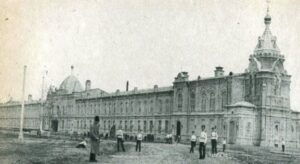
Cadet corps where the Institute was located (1920)
During that period 205 students studied at the 5 courses of the Faculty of Medicine. Five of them were representatives of the local population. In May 1921 the first 12 students graduated from the faculty and 27 students graduated in 1922. Among them there were representatives of the local population Z.I. Umidova and A. Dashanova. At first from the representatives of the local population T. Najmitdinov, M. Ismailov, A. Askarov, K. Usmanov, M. Mirsagatov, Yu. Ahmedjanov, H. Inayatov and Sh. Rahimov studied at the Faculty of Medicine. In subsequent years the faculty was headed by Professors K.G. Khrushyev (1921–1924) and M.I. Slonim (1924–1926). During that period the material and technical base of the faculty and teaching at clinical departments was improved significantly. In order to improve the quality and efficiency of education new teachers were invited including Professor N.I. Ragoza (Internal and Infectious Diseases), A.N. Murzin (Eye Diseases), I.S. Milman (Skin and Venereal Diseases), N.I. Osipovsky (Children Diseases), S.A. Molchanov (Radiology), G.N. Terehov (Pathological Anatomy), G.I. Ilyin (Operative Surgery), S.E. Zimmerman (Normal Anatomy), M.S. Astrov (Faculty Surgery), D.A. Vvedenskiy (Urology), and etc. 973 students studied at the Faculty of Medicine in 1923 most of whom (425) were girls. In a short period of time the material and technical base of the clinics was improved and new premises were created. In order to prepare highly qualified teaching staff the postgraduate studies were opened at the faculty. A great contribution to the development of the faculty was made by the deans of the faculty P.F. Borovsky (1926-1928), N.I. Ragoza (1928- 1929) and G.P. Fyodorov (1929-1931). In 1931 Medical Faculty was transformed into an independent Central Asian Medical Institute and G.P. Fyodorov was appointed its first director. By the end of that year he was transferred as a dean of the Medical Faculty and H.U. Umarov was appointed as director of the Institute. 177 teachers (25 professors, 26 assistant professors, 104 assistants) taught 1099 students in 1932. In 1932-1936 B. Sattarov was rector of the Institute. In 1935 Central Asian Medical Institute was renamed Tashkent Medical Institute (TMI). In its structure the Facultiy of Medical prophylactics and Sanitary Hygiene and The Faculty of Pediatrics and Dentistry started functioning. In 1937 1400 students studied at the Institute. The teachers personnel expanded from year to year as well as the number of the representatives of the local population who had graduated from the same Institute. It should be noted the names of the teachers such as Professors A.A. Akovbyan (Skin and Venereal Diseases), A.A. Askarov, E.I. Atahanov, G.A. Bussel (Therapy), G.L. Weinstein (Obstetrics and Gynecology), N.I. Ismailov (Therapy), S.A. Masumov (Surgery), A.S. Melik-Karamyan (Therapy), I.G. Gasparyan (Phthisiology), A.V. Georgievsky (Epidemiology), A.M. Geller (Surgery), I.A. Kassirsky, T.H. Najmitdinov (Tropical Diseases), N.N. Kompantsev (Pharmacology), M.F. Mirochnik, O.N. Pavlova, Z.I. Umidova (Therapy), B.A. Stekolnikov (Operative Surgery), K.G. Titov (Pediatrics), A.Yu. Yunusov (Normal Physiology), A.I. Magrupov (Pathological Anatomy). M.U. Mirsagatov was a rector of the Institute in 1938-1940. In 1940 B.I. Berliner and in 1941 R.I. Pulatov were appointed as rectors. By that time many new buildings of the Institute were built (experimental building, Clinics for Infectious Diseases, Oncology, Orthopedics), and the existing ones were repaired. In 1920 the number of the beds in the clinics of the Institute was 525 and by 1949 During that period 205 students studied at the 5 courses of the Faculty of Medicine. Five of them were representatives of the local population. In May 1921 the first 12 students graduated from the faculty and 27 students graduated in 1922. Among them there were representatives of the local population Z.I. Umidova and A. Dashanova. At first from the representatives of the local population T. Najmitdinov, M. Ismailov, A. Askarov, K. Usmanov, M. Mirsagatov, Yu. Ahmedjanov, H. Inayatov and Sh. Rahimov studied at the Faculty of Medicine. In subsequent years the faculty was headed by Professors K.G. Khrushyev (1921–1924) and M.I. Slonim (1924–1926). During that period the material and technical base of the faculty and teaching at clinical departments was improved significantly. In order to improve the quality and efficiency of education new teachers were invited including Professor N.I. Ragoza (Internal and Infectious Diseases), A.N. Murzin (Eye Diseases), I.S. Milman (Skin and Venereal Diseases), N.I. Osipovsky (Children Diseases), S.A. Molchanov (Radiology), G.N. Terehov (Pathological Anatomy), G.I. Ilyin (Operative Surgery), S.E. Zimmerman (Normal Anatomy), M.S. Astrov (Faculty Surgery), D.A. Vvedenskiy (Urology), and etc. 973 students studied at the Faculty of Medicine in 1923 most of whom (425) were girls. In a short period of time the material and technical base of the clinics was improved and new premises were created. In order to prepare highly qualified teaching staff the postgraduate studies were opened at the faculty. A great contribution to the development of the faculty was made by the deans of the faculty P.F. Borovsky (1926-1928), N.I. Ragoza (1928- 1929) and G.P. Fyodorov (1929-1931). In 1931 Medical Faculty was transformed into an independent Central Asian Medical Institute and G.P. Fyodorov was appointed its first director. By the end of that year he was transferred as a dean of the Medical Faculty and H.U. Umarov was appointed as director of the Institute. 177 teachers (25 professors, 26 assistant professors, 104 assistants) taught 1099 students in 1932. In 1932-1936 B. Sattarov was rector of the Institute. In 1935 Central Asian Medical Institute was renamed Tashkent Medical Institute (TMI). In its structure the Facultiy of Medical prophylactics and Sanitary Hygiene and The Faculty of Pediatrics and Dentistry started functioning. In 1937 1400 students studied at the Institute. The teachers personnel expanded from year to year as well as the number of the representatives of the local population who had graduated from the same Institute. It should be noted the names of the teachers such as Professors A.A. Akovbyan (Skin and Venereal Diseases), A.A. Askarov, E.I. Atahanov, G.A. Bussel (Therapy), G.L. Weinstein (Obstetrics and Gynecology), N.I. Ismailov (Therapy), S.A. Masumov (Surgery), A.S. Melik-Karamyan (Therapy), I.G. Gasparyan (Phthisiology), A.V. Georgievsky (Epidemiology), A.M. Geller (Surgery), I.A. Kassirsky, T.H. Najmitdinov (Tropical Diseases), N.N. Kompantsev (Pharmacology), M.F. Mirochnik, O.N. Pavlova, Z.I. Umidova (Therapy), B.A. Stekolnikov (Operative Surgery), K.G. Titov (Pediatrics), A.Yu. Yunusov (Normal Physiology), A.I. Magrupov (Pathological Anatomy). M.U. Mirsagatov was a rector of the Institute in 1938-1940. In 1940 B.I. Berliner and in 1941 R.I. Pulatov were appointed as rectors. By that time many new buildings of the Institute were built (experimental building, Clinics for Infectious Diseases, Oncology, Orthopedics), and the existing ones were repaired. In 1920 the number of the beds in the clinics of the Institute was 525 and by 1949 their number reached 1665. During that period 336 000 patients were treated in the clinics of the Institute. During the Second World War in 1941- 1945 more than 10 evacuation hospitals were opened on the territory of the Institute. Many professors and teachers went to the front including D.A. Vvedensky, L.D. Vasilenko, A.M. Geller, B.A. Stekolnikov and others. In 1944 Ya.K. Muminov was appointed as a rector of the institute. During the war years Tashkent State Medical Institute (TSMI) trained 2122 doctors 1630 of whom went to the war. There were M.A. Ashrapova, M. Muharramova, S.A. Fayziev, N.K. Ahmedov, M. Akmalov, U. Umarov, V.S. Karpuhina, L.I. Vaskovskaya
| # | Course | Seats | 1st Yr Fee | From Next Yr | Total Fee | Cash Back | Lodging Fee | Fooding Fee | Course Duration |
|---|---|---|---|---|---|---|---|---|---|
| 1 | MBBS | 40 | $4100 | $4100 | $24,600 | BOOK, TAB | $800 P/Y | $110 P/M | 6 years |
1) Registration :- Send us scan copy of marksheet 10th & 12th Aahar card / passport document with of your passport size photo at info@imaginecareer.in/ www.imaginecareer.in and send the registration amount to the given account number.
2) Admission confirmation :- As soon as the admission letter comes you need to submit the second installment of the processing charge with original passport , original documents with some additional documents as instructed.
3) Visa Application :- Once the documents has been submitted at the Embassy and the visa receiving date has been confirmed , the student need to give the third installment's soon as the passport will be received with visa stamping , all the originals will be given back.
4) Travel Information :- The last step is the travel arrangements which will be done by us, we will be giving you all the necessary details about the departure time, arrival time, who will be receiving at the airport etc. The last installment of processing fee will be given then.
we assist the student in medical in Medical Counsil of India's eligibility certificate process, exchanging indian ruppees in dollars, assist in parents visa if required, loan letter from university in case the students want to get loan and other important things to.


